Starship Flight 15: SpaceX Targets First Double Catch on November 13
SpaceX's Starship Flight 15 is set for 13 November from Starbase, aiming to catch both the Super Heavy booster and the ship. Here is the full flight plan.

Key points
- SpaceX is targeting Friday, 13 November 2026 for Starship Flight 15 from Starbase, Texas, with a 75-minute window opening at 5:45 p.m. EST, pending regulatory approval.
- Flight 15 will try to catch both the Super Heavy booster and the Starship upper stage with the launch tower's arms, which would be the first full recovery of an orbital rocket.
- The booster catch is planned about 6 minutes 35 seconds after liftoff, while the ship would attempt its catch about 22 hours 32 minutes after launch, after roughly 14 orbits.
- Ship 42 is set to deploy 26 Starlink V3 satellites, three of which carry cameras to inspect Starship's heatshield in flight.
- SpaceX says the ship will only head back to the launch site if flight controllers confirm that critical systems for reentry, the landing burn and the tower approach are healthy.
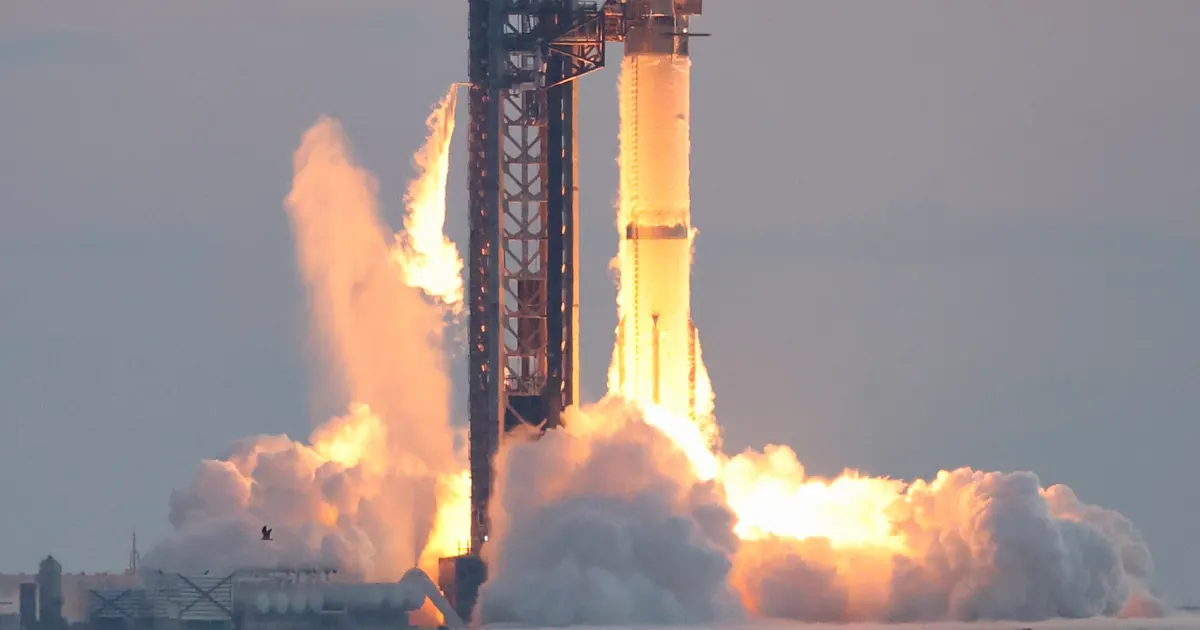
SpaceX is preparing to launch Starship Flight 15 on Friday, 13 November 2026, from its Starbase site in South Texas, with a plan to catch both the Super Heavy booster and the Starship upper stage with its launch tower. If both catches work, it would be the first time an orbital-class rocket has been fully recovered, a key step towards the cheap, rapid reuse that SpaceX needs for Starlink and NASA’s Moon programme. The launch still depends on regulatory approval.
When does Starship Flight 15 launch?
According to WFTV, SpaceX has set a 75-minute launch window that opens at 5:45 p.m. EST (4:45 p.m. CT) on 13 November. Teslarati reports the rocket will lift off from Orbital Launch Pad 2 at Starbase. SpaceX vice president of launch Kiko Dontchev gave the date at the UP.Summit, according to Ars Technica’s reporting cited by Teslarati.
SpacePolicyOnline lists the flight as scheduled pending regulatory approval. As of 5 November, the Federal Aviation Administration’s Starship page did not yet show a Flight 15 licence. SpaceX President Gwynne Shotwell said in October that, after extensive talks with the FAA, she expected the licence to cover a return to the launch site and tower catches for both stages.
What is SpaceX trying to do on Flight 15?
The flight uses Booster 22 and Ship 42, both from the newer, larger Block 3 generation of Starship hardware. The plan has two catches:
- The booster catch: after stage separation, Super Heavy flies a boostback burn and returns to Starbase, where the tower’s mechanical “chopstick” arms try to grab it about 6 minutes and 35 seconds after liftoff. WFTV notes this is the first return and catch attempt for a V3 booster.
- The ship catch: Ship 42 goes into an orbit of roughly 275 km, deploys its satellites and circles Earth about 14 times over more than 22 hours. It then fires a deorbit burn, re-enters, flips and performs a landing burn for a catch attempt at around 22 hours and 32 minutes after launch.
If the launch happens at the start of the window, SpacePolicyOnline puts the ship catch at around mid-afternoon US Eastern time on Saturday, 14 November. If either catch is not viable, the backup plan is a splashdown: in the Gulf of Mexico for the booster and in the Pacific for the ship.
SpaceX has said the ship will only try to return to the launch site if flight controllers judge that its critical systems, including those for reentry, the landing burn and the tower approach, are healthy.
What will the ship carry?
Ship 42 is set to deploy 26 Starlink V3 satellites, the same number carried on Flight 14. WFTV reports that each V3 satellite adds one terabit per second of capacity to the Starlink network, so this batch roughly equals ten Falcon 9 launches of the older V2 Mini satellites.
Three of the satellites have a special job. They carry camera suites that will photograph Starship’s heatshield during the flight, and those images will help SpaceX decide whether the ship is fit to come back to Starbase.
What changed after Flight 14?
Flight 14 launched on 28 September 2026 and became the first Starship to reach orbit. It deployed 26 Starlink V3 satellites and splashed down in the Indian Ocean, although a Raptor engine shut down early during ascent.
For Flight 15, SpaceX has reworked the heatshield. According to WFTV, it added tile retention mechanisms in areas at high risk of losing tiles on ascent, sealed paths that had let hot plasma get behind the heatshield, and used a curved tile design over a large part of the ship, which tests showed reduces heating in the gaps between tiles.
Both vehicles have finished their engine tests. Booster 22 fired all 33 Raptor engines on 25 October, and Ship 42 completed a single-engine burn that simulated a deorbit manoeuvre on 26 October, followed by a full-duration firing of all six engines the next day. Ship 42 also rehearsed the catch in September, when the tower arms lifted it into position.
Why does a Starship catch matter?
SpaceX has caught Super Heavy boosters on three earlier flights (Flights 5, 7 and 8), most recently in March 2025, but it has never tried to catch the ship. Returning the upper stage to land is much harder: it comes back from orbit at far higher speed, must survive reentry heating, and needs a new reentry path over land rather than the open-ocean finishes of every earlier flight.
Elon Musk said on SpaceX’s third-quarter earnings call that a successful ship catch was “more likely than not.” SpaceX expects tower catches of both stages to become routine, which it says would shorten the time between flights and raise its launch rate.
The stakes go beyond Starlink. NASA is relying on a modified Starship as a lunar lander, and it recently picked Starship to launch communications satellites towards the Moon in 2028. Interesting Engineering notes that the lunar version must still demonstrate in-space propellant transfer on a future flight.
What happens next?
Musk has already described Flight 16, on which both stages would fly again. On the regulatory side, the FAA will hold public scoping meetings on increasing Starship launches from Starbase on 17 November in Brownsville, Texas, and online on 18 November.
The same Friday is busy at Cape Canaveral too: SpacePolicyOnline reports that United Launch Alliance plans to fly its Vulcan rocket on 13 November with 40 Amazon Leo satellites, its first launch since February. For more launches and missions, see our ESCAPADE Earth flyby coverage.
Frequently asked questions
When is Starship Flight 15?+
SpaceX is targeting Friday, 13 November 2026 for Starship Flight 15 from Orbital Launch Pad 2 at Starbase, Texas. The 75-minute window opens at 5:45 p.m. EST (4:45 p.m. CT), and the launch still depends on regulatory approval.
What is the Starship double catch?+
On Flight 15 SpaceX wants the launch tower's mechanical 'chopstick' arms to catch both stages: the Super Heavy booster minutes after liftoff and the Starship upper stage after about 22 hours in orbit. The booster has been caught before, but no Starship upper stage has ever been caught.
What will Starship Flight 15 carry?+
Ship 42 is set to deploy 26 Starlink V3 satellites, the same number as on Flight 14. Three of them carry camera suites that will photograph Starship's heatshield, and the images will help decide whether the ship returns to Starbase.
Sources
- WFTV/WDBO – SpaceX Starship Flight 15 aims for first full recovery
- SpacePolicyOnline – What's Happening in Space Policy November 8-14, 2026
- Teslarati – SpaceX's next Starship flight set to make history on Friday the 13th
- Space.com – SpaceX fires up Starship upper stage ahead of landmark Flight 15 test launch
- Interesting Engineering – SpaceX Starship Flight 15: launch date and objectives
- SpaceX Starship
- SpaceX
- Super Heavy
- Starlink
- Starbase
- Reusable rockets

PFM Today Newsroom · News Desk
The PFM Today Newsroom tracks developments across startups, AI, design, business and more. Stories are researched from primary sources and reputable outlets, written with AI assistance, and reviewed against our editorial policy before publishing. Read our editorial policy.