Geminid Meteor Shower 2026: Peak Date, Moon and How to Watch
The Geminid meteor shower 2026 peaks on the night of 13–14 December with up to 150 meteors an hour and a thin Moon. Here is when and how to watch.
Key points
- The Geminid meteor shower 2026 peaks on the night of 13–14 December, with the predicted maximum around 14:00 UTC on 14 December, according to Star Walk citing the International Meteor Organization.
- Under dark skies the Geminids can produce up to about 150 meteors per hour, while suburban observers may see 25 to 50, according to the Farmers' Almanac.
- The Moon is a thin waxing crescent, about 20 percent lit, and sets in the early evening, leaving the rest of the peak night dark.
- The shower is active from early December, with sources giving 4 December as the start and an end date of 17 to 20 December.
- The Geminids come from asteroid 3200 Phaethon, not a comet, and are visible from both hemispheres, though best from the Northern Hemisphere.
The Geminid meteor shower 2026 peaks on the night of 13–14 December, and this year’s conditions are good: the Moon is only a thin crescent and sets early in the evening. Under a dark sky the Geminids can deliver up to about 150 meteors an hour, making them one of the strongest showers of the year. This guide explains the peak date, the Moon, the best time to look and how to watch from cities, Pakistan and elsewhere. All details are as of 17 November 2026.
What is the Geminid meteor shower?
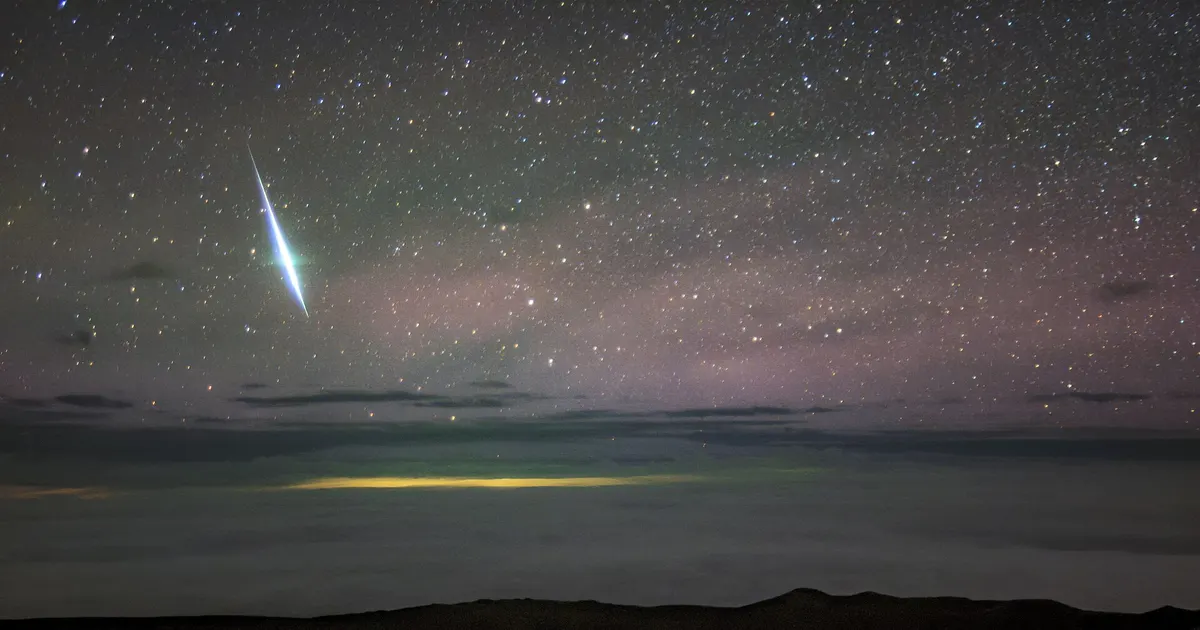
The Geminids are a meteor shower that returns every December. Like other showers, they happen when Earth passes through a stream of debris and small grains burn up in the upper atmosphere as streaks of light.
What makes the Geminids different is their source. Most meteor showers come from comets, but the Geminids come from an asteroid, 3200 Phaethon. Phaethon was discovered in 1983 and is a rocky body about 5 to 6 kilometres across, depending on the source, which circles the Sun every 1.4 years and passes unusually close to it.
The meteors appear to come from a point in the constellation Gemini, near its two bright stars Castor and Pollux. That point is called the radiant, and it gives the shower its name. The Farmers’ Almanac puts Geminid speeds at about 22 miles (roughly 35 kilometres) per second, around half the speed of the Perseids, which helps make them easier to follow by eye.
Geminids 2026 quick facts
| Detail | 2026 information |
|---|---|
| Active period | From 4 December to 17 December (Star Walk) or 20 December (Farmers’ Almanac) |
| Peak night | 13–14 December 2026 |
| Predicted maximum | About 14:00 UTC on 14 December (Star Walk, citing the IMO) |
| Rate under dark skies | Up to about 150 meteors per hour |
| Rate from suburbs | About 25 to 50 per hour (Farmers’ Almanac) |
| Moon | Waxing crescent, about 20% lit, sets in the early evening |
| Radiant | Gemini, near Castor and Pollux |
| Parent body | Asteroid 3200 Phaethon |
When is the Geminids 2026 peak date?
The main night to watch is Sunday 13 December into Monday 14 December 2026. Star Walk, citing the International Meteor Organization (IMO) 2026 calendar, gives the predicted maximum at around 14:00 UTC on 14 December, with enhanced activity from about 21:00 UTC on 13 December to 18:00 UTC on 14 December. It notes that Geminid rates above 100 an hour can last for 10 to 12 hours, so the shower stays strong for a long window.
What that means where you are:
- Europe and Africa: the night of 13–14 December is best, with high rates through the early hours of the 14th.
- The Americas: the night of 13–14 December is best, as the maximum falls after dawn on the 14th.
- Pakistan, India and the Gulf: both nights are worth trying. The predicted maximum falls around 7 pm Pakistan time on 14 December, when Gemini is rising in the east, so the evening and night of the 14th may be especially good.
- East Asia and Australia: the night of 14–15 December starts close to the predicted maximum.
What will the Moon be like?
The Moon will not be much of a problem in 2026. New Moon falls on 9 December (00:52 UTC, which is the evening of 8 December in the Americas), so by the peak the Moon is a thin waxing crescent.
PFM Today’s calculation with the PyEphem astronomy library gives a Moon about 19 to 22 percent lit over the peak night. It sets early in the evening: around 8:45 pm in Lahore, 8 pm in London and 8:45 pm in New York on 13 December. The Farmers’ Almanac similarly says the Moon sets by about 9 pm local time on the peak night. After that, the sky is dark for the rest of the night. The next full Moon is not until 24 December (UTC).
What is the best time to see the Geminids?
Unlike most showers, the Geminids start early. Gemini rises in the north-east around nightfall, so meteors can appear from mid-evening. Rates climb as the radiant gets higher, and Star Walk says activity is strongest around 2 am local time, when Gemini is highest in the sky.
A good plan for 2026:
- Start watching after the Moon sets, from about 9 pm local time.
- Keep going until at least 2 am if you can, when rates are usually best.
- If you have a second chance, try the following night too, especially in Asia.
How to watch the Geminid meteor shower
You do not need any equipment. These steps make the biggest difference:
- Get away from lights. The Farmers’ Almanac says driving at least 30 minutes from a city can roughly double the number of meteors you see.
- Let your eyes adjust. Give yourself 20 to 30 minutes in the dark and avoid looking at your phone screen.
- Look at a wide area of sky. Meteors can appear anywhere. Looking about 45 degrees away from Gemini tends to show longer streaks.
- Skip the telescope. Binoculars and telescopes show too small a patch of sky.
- Dress for the cold. December nights are cold in the Northern Hemisphere. Bring a blanket, a reclining chair and a hot drink.
- Check the weather. Clouds are the biggest risk, so check your local forecast on the day.
Watching from a city
From a city you will only see the brighter meteors, perhaps 25 to 50 an hour from the suburbs and fewer from a city centre. Find a dark spot such as a park or rooftop, shield your eyes from streetlights and be patient.
Can you see the Geminids from the Southern Hemisphere?
Yes, but rates are lower. Star Walk says the shower can be seen from almost anywhere on Earth, but the radiant does not climb very high in the south, so fewer meteors are visible. Southern observers should watch from around midnight into the pre-dawn hours of 14 December.
Geminids vs Leonids: how do they compare?
The Geminids are far stronger than November’s Leonids, which manage only around 10 to 15 meteors an hour at best. The Leonids are much faster but fewer. If you missed them, see our Leonid meteor shower 2026 guide for how this year’s display was expected to look.
The bottom line
Mark the night of 13–14 December 2026 in your calendar. With a thin Moon that sets early, dark skies after about 9 pm and rates of up to around 150 meteors an hour from a dark site, the 2026 Geminids are worth a cold night outside. Check the weather, get away from lights and give your eyes time to adjust.
Frequently asked questions
When is the Geminid meteor shower peak in 2026?+
The Geminids peak on the night of 13–14 December 2026. Star Walk, citing the International Meteor Organization calendar, gives a predicted maximum around 14:00 UTC on 14 December, with enhanced activity from about 21:00 UTC on 13 December to 18:00 UTC on 14 December.
What is the best time to see the Geminids?+
The Geminids are unusual because they start in the evening. The radiant in Gemini rises around nightfall, and rates are highest when it is high in the sky, around 2 am local time. The Moon sets early in the evening, so most of the night is dark.
Can I see the Geminids from Pakistan?+
Yes. In Pakistan the predicted maximum falls around 7 pm on 14 December, when Gemini is rising in the east. Watch from mid-evening on both 13 and 14 December, ideally away from city lights.
Do I need a telescope to see the Geminids?+
No. Telescopes and binoculars show too small a patch of sky. The best way to watch is with the naked eye, lying back and looking at a wide area of dark sky.
Sources
- Geminids
- Meteor shower
- 3200 Phaethon
- Stargazing
- Night sky

PFM Today Newsroom · News Desk
The PFM Today Newsroom tracks developments across startups, AI, design, business and more. Stories are researched from primary sources and reputable outlets, written with AI assistance, and reviewed against our editorial policy before publishing. Read our editorial policy.