Hera Finds Stadium-Sized DART Crater on Asteroid Dimorphos
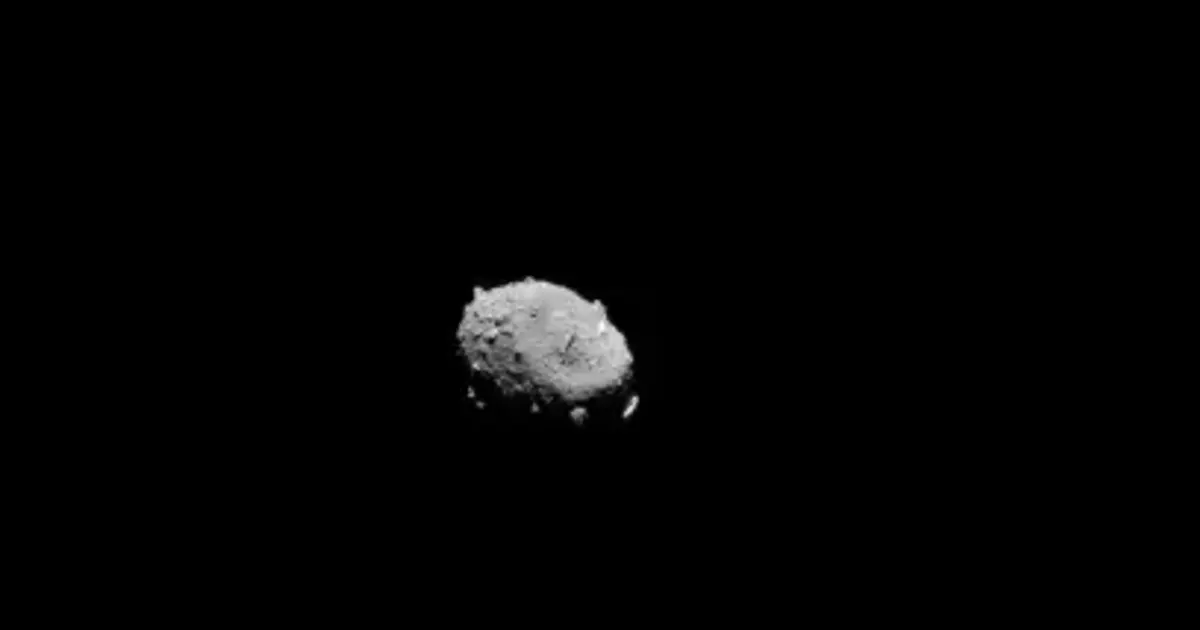
ESA's Hera has shown the DART crater on Dimorphos for the first time: a stadium-sized scar across one face, with the asteroid now tumbling chaotically.
Key points
- ESA released Hera's first close-up images of the DART impact site on asteroid Dimorphos on November 25, 2026, at the Museum für Naturkunde in Berlin.
- NASA's DART spacecraft left a crater the size of a sports stadium that stretches across the whole width of Dimorphos, flattening one face of the 151-metre asteroid.
- Hera's images show that Dimorphos is now tumbling chaotically in its orbit around the larger asteroid Didymos.
- Hera also found hundreds of previously unknown boulders, a few metres across, orbiting the asteroid pair.
- Hera will move to about 13 km from the asteroids in December and release two CubeSats, Milani and Juventas, in January 2027.
The European Space Agency’s Hera spacecraft has sent back the first close-up images of the crater NASA’s DART probe left on asteroid Dimorphos, four years after the 2022 impact. ESA unveiled the pictures in Berlin on November 25, 2026. They show a crater the size of a sports stadium stretching across the asteroid’s whole width, with Dimorphos now tumbling chaotically. The results are the first direct look at what deliberately hitting an asteroid actually does to it.
What did Hera find on Dimorphos?
Before Hera arrived, scientists had three main predictions for what DART might have done to the 151-metre asteroid: left a crater, reshaped the whole body, or barely changed it. Hera principal investigator Patrick Michel said “the answer turns out to be all three at once!”
According to ESA:
- A huge crater: one face of Dimorphos has been flattened by a stadium-sized crater that runs across the entire width of the asteroid.
- A chaotic tumble: instead of spinning in a steady way, Dimorphos is now tumbling as it orbits its larger partner, Didymos. ESA mission scientist Michael Kueppers told reporters the asteroid “is now tumbling in a chaotic way,” ABC News reported.
- Little change elsewhere: the far side looks much as it did in DART’s last images, with boulder fields still where they were. Kueppers said the team saw no evidence of major changes opposite the impact site.
- Hundreds of boulders: Hera spotted hundreds of previously unknown boulders, each just a few metres across, orbiting the pair.
Popular Science reported that one key image was taken by Hera’s Asteroid Framing Camera on November 7 from 29 km away, at a resolution of 2.7 metres per pixel. The crater appears as wide as the struck face of the asteroid, with what looks like a cigar-shaped structure at its centre.
How did Hera take the images?
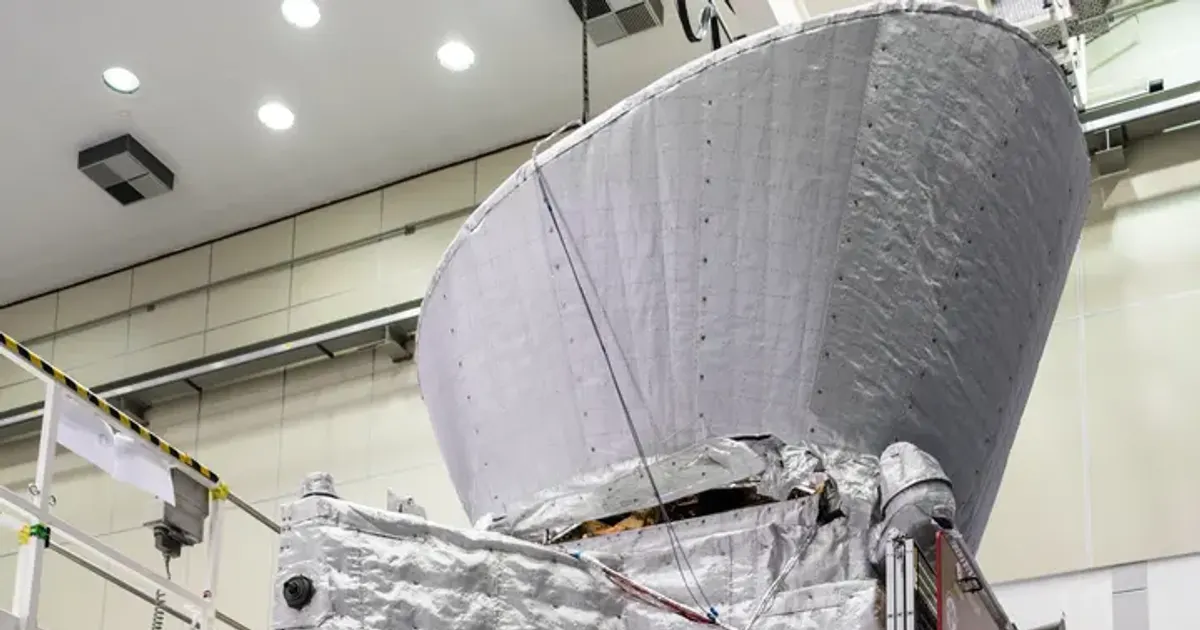
Hera, a spacecraft about the size of a small car, reached the Didymos system in early November and is now flying in rectangular paths about 25 to 30 km from the two asteroids. It moves slowly, at an average of about 12 cm per second relative to them.
Three instruments produced the first results: the monochrome Asteroid Framing Camera; Hyperscout H, a multispectral imager that sees 25 colours at once; and the Thermal Infrared Imager supplied by Japan’s space agency, JAXA. ESA compared Hera’s views with pictures from DART’s own DRACO camera to show what changed.
Earlier this month, Hera’s first close-up of Didymos revealed the side of the larger asteroid that DART never saw.
Why does it matter for planetary defence?
DART struck Dimorphos on September 26, 2022, at about 22,500 km/h. It shortened the moonlet’s orbit around Didymos by about 33 minutes, much more than predicted, proving that a spacecraft can nudge an asteroid. What DART could not show was the full result of the hit.
That is Hera’s job. By measuring the crater, the asteroid’s new shape and, later, its mass and interior, scientists can work out how much of the push came from debris thrown off the surface. That knowledge is needed to plan a real deflection mission if a dangerous asteroid were ever found on a collision course with Earth.
Hera mission manager Ian Carnelli, who presented the images in the museum’s dinosaur hall, noted that “NASA’s DART mission demonstrated that we can change an asteroid’s orbit.” ESA Director General Josef Aschbacher said Hera shows Europe’s role in “an endeavour that ultimately benefits all of humankind.”
Key details
| Item | Detail |
|---|---|
| Spacecraft | ESA Hera, built by an 18-country consortium led by OHB |
| Target | Dimorphos (151 m), moon of Didymos (730 m) |
| DART impact | September 26, 2022 |
| Orbit change from DART | About 33 minutes shorter |
| Distance from Earth | About 193.5 million km |
| Current Hera distance | About 25–30 km from the asteroids |
What happens next?
In December, Hera will move in to about 13 km from the asteroid pair and take sharper images. In January 2027 it will release two shoebox-sized CubeSats. Juventas, led by Luxembourg, will use low-frequency radar to look inside an asteroid for the first time and will eventually attempt a landing. Milani, led by Italy, will study the materials on the surface and the dust around the asteroids.
ESA says Hera and its two CubeSats will measure Dimorphos’s mass, surface and internal structure in far greater detail during these close-range operations, filling in the parts of the DART experiment that could not be seen from Earth.
Frequently asked questions
How big is the DART crater on Dimorphos?+
ESA describes it as the size of a sports stadium. It extends across the entire width of Dimorphos, which is about 151 metres across, leaving one face of the asteroid flattened. ESA has not yet published an exact diameter or depth.
What did Hera discover about Dimorphos?+
Hera found that DART left a large crater, changed the shape of one side of Dimorphos and sent it tumbling chaotically, while the opposite side looks largely unchanged. It also spotted hundreds of small boulders orbiting the asteroid pair.
What is next for the Hera mission?+
In December 2026 Hera will close to about 13 km from Didymos and Dimorphos for sharper images. In January 2027 it will release two shoebox-sized CubeSats: Juventas, which will probe the asteroid's interior with radar and try to land, and Milani, which will study surface materials and dust.
Sources
- ESA – Hera reveals stadium-sized asteroid crater from spacecraft impact
- ESA media advisory – Four years after NASA's asteroid impact, ESA's Hera reveals what happened to Dimorphos
- ABC News – New photos reveal stadium-sized crater in Dimorphos asteroid knocked off course by NASA
- Popular Science – NASA spacecraft created stadium-sized crater after slamming into asteroid
- Hera
- ESA
- Dimorphos
- DART
- Planetary defence
- Asteroids

PFM Today Newsroom · News Desk
The PFM Today Newsroom tracks developments across startups, AI, design, business and more. Stories are researched from primary sources and reputable outlets, written with AI assistance, and reviewed against our editorial policy before publishing. Read our editorial policy.